Vancouver – Big Data, Integration & Governance Forum

My first year as an IBM Champion for Information Management is quickly coming to an end and I could not think of a more appropriate way to cap it off then to return to Vancouver and present my viewpoints on “Strategy & Governance” to an audience of former peers and friends.

If you are going to be in the Vancouver area on March 4th, please register at the link provided and we can catch up on the day. I will be giving my presentation along with participating in a Panel Discussion and joining in the conversation at lunchtime. I am very much looking forward to this event. See you there!

“N.S.A. Gathers Data on Social Connections of U.S. Citizens” (NYT – Sunday, September 29, 2013)

Is there any “Illusion of Privacy” left at this point after such headlines? Doubtful, I would imagine. 

On Monday, September 30th @ 12:00 EDT I will be participating in a live TweetChat on #CXO entitled “Customer Privacy in the Age of Transparency”. For those who can follow along or tweet we are going to get into the meat of the topic of “The Illusion of Privacy and How to Contend with it”.

Here are some questions that we will be exploring during out 60-minute TweetChat:

  1. Is transparency helping or hindering the customer experience? Explain
  2. Can big data, transparency and privacy live together in harmony? Why or why not?
  3. Is it the customer’s job to protect their privacy? Whose job is it?
  4. Should privacy factors dictate how long customer data is kept? Why or why not?
  5. Who should determine what can and can’t be done with customer data? Should the customer have a say on social data?
  6. Can businesses trust their sources of customer data? How can they improve veracity?
  7. How can businesses incorporate governance into their customer data collection plans?
  8. What should tomorrow’s consumer privacy policies and plan look like?

A lot of material to cover is just one hour so be prepared. 

See you tomorrow.

“N.S.A. Gathers…

MIT PhotoLast Weeks’ MIT Chief Data Officer and Information Quality Summit was a social media bonanza given the wide rage of coverage and groundswell of advocacy coming from all the camps who have a vested interest in seeing the concept of the “Data Czar” come to fruition. It was no less feverish of an event than those focused on Big Data or the role of the Data Scientist. It was truly an interesting spectacle to observe. I look forward to attending the next one of these “data fests” in the coming months.

As promised in my earlier postings on the Summit here is my Summary in the form of “Five Key Takeaways”

1.- There is no agreement as to “What is a Chief Data Officer?” It is an amorphous role description and has been designed to invoke thought rather than to define just what this executive should be Accountable and Responsible for in the grand scheme of things.

“Data is not stuff. It is the lifeblood of your enterprise and the Business is fully accountable for its Management and Leadership”

2.- A cross-sectional view of the CDO’s in attendance at the event (and a sampling of those not) indicates to me that this is (unfortunately) an IT role in most enterprises who have adopted it so far. This is disappointing, but not a surprise, given the lack of accountability for Information Management that most business leaders have failed to assume.

“IT is neither a seat of power nor influence in today’s enterprise. It is a cost center responsible for Service Delivery”

3.- Regulatory Compliance continues to be the dominant focus for all CDO Discussions and Activities. Keeping their CEO from being broadcast live during their “perp walk in his/her orange jumpsuit” for failure to accurately report on SARBOX, Dodd-Frank, Basel III, etc. is the major motivation for most CDO’s in Financial Services today.

“Risk and Compliance activities can be sources of Competitive Advantage for many enterprises if addressed as “strategic and core” rather than “necessary and evil” by the Organization and its Data/Information strategists and practitioners”

4.- MIT at large is studying (and experimenting with) the Chief Data Officer phenomena very closely. Using “Big Data” sources such as Interviews, Surveys and Social Media they are building a very detailed view (and analysis) of “The What and the Why” around the CDO and Data Scientist frenzies. Their “Cube” model (see my last posting) is a very interesting endeavor in respect to behavioral analysis and the tenants of good organizational design.

“To design a future state Organization focused on creating and embedding a culture of Information Management, Exploitation and Stewardship within it requires a deep understanding of the psyche of the current organization and its ability to change and adapt”

5.- The MIT CDO and Information Quality Summit has its roots in the study and analysis of Data Quality. It has been around for many years now and has only recently added the context of “Chief Data Officer” to its remit. However, the need to radically improve Data Quality has never been more paramount across all enterprises. We have yet to take this matter seriously and continue to treat it as a downstream activity or more cynically as “A hazard of doing business”. The more that we focus on the bright shiny objects of Big Data, Data Scientists, Chief Data Officers, etc. the less that we want to sustain the need to be ever-vigilant on improving Data Quality over the entire lifecycle for Information. We seem to have relegated ourselves to creating more of the same low quality data to attempt to analyze and make decisions from.

“Fundamentally, most data used by Organizations for Decision Making, Reporting and Insights/Analysis is suspect at best. We don’t understand its Provenance and resist all forms of Governance in terms of acceptable usage and behavior”.

As a final note, I will be writing a series of articles on the Chief Data Officer role for Information Age ( http://www.information-age.com/ ) over the coming months as well as speaking on it at upcoming industry events in the US & UK.

Stay Tuned!

Day 3 - MIT Chief Data Officer & Information Quality Forum

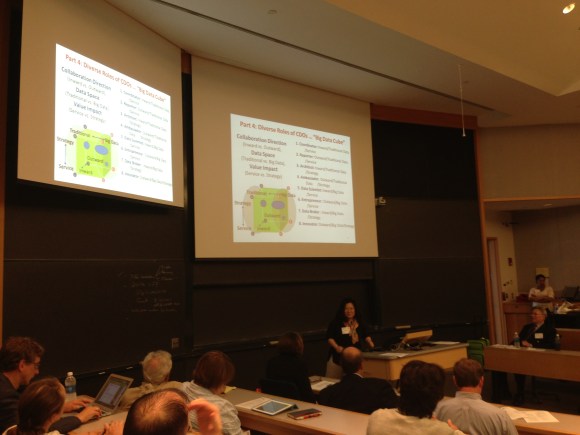
MIT Researchers explain their “CDO Big Data Cube” model for the types of Chief Data Officers based on their Interviews, Survey Responses and Other Contributions.

Their core definition of the CDO is an individual who has the expertise to adequately Lead and Administrate these 4-Critical Dims:

1.- Data Quality
2.- Data Governance
3.- Data Strategy
4.- Data Architecture

While these are critical elements of what I call an “Information Management Executive” (and many are now calling Chief Data Officer), there are several others that are just as important;

5. -Executive Leadership and Administration
6.- Communications & Collaboration Excellence
7.- Political Astuteness

All of these critical capabilities manifest into the “the entire package”. Many at this week’s conference doubted the need for deep domain skills as found in points 1-4, but all believe that 5-7 were essential to success. I believe that all are required as Leadership must be demonstrated on both fronts (Business & Technical).

In my next posting I will summarize the Forum altogether and provide my viewpoint on the need for both a unified vision and definition of this critical role no matter how you refer to it.

Standby!

“Data is the responsibility of the business, not IT” or alternatively “Data should be a Business Issue, not a Technical one”

One of the few consensus themes coming out of this CDO & Information Quality confab is that “The Business must rise to the occasion and assume its natural Accountabilities and Responsibilities associated with the Information (not data) it uses”. Abdicating these to IT for so many years now has resulted in the chaos and lack of strategic direction that we now must contend with. I salute this wholeheartedly. 

It has been a pleasure to see many representatives from the Business side here at the conference, many of which speaking from a voice of leadership and accountability. Unfortunately, the role of the Chief Data Officer continues to be part of the IT Organization in far too many enterprises. This must change immediately (much less shifting the focus from “data” to “Information”. I could go on about this for hours).

I will be preparing a summary of the entire Conference early next week. In the meantime continue to enjoy my snarky tweets along the way.


“Data is the re…

MIT Chief Data Officer & Information Quality Symposium, Cambridge, MA

On Day 1 of the CDOIQ Symposium we heard from a number of Government & Industry Leaders and Academics on the subject of “The Role & Reporting Structure of the CDO” and “How we can create as many Data Scientists in 1-year as we do MBAs”. (not quite sure that the world is ready for this, but…). Today (Day 2) we will dig into this further with Panel discussions and testimonials from current CDO’s. We will even get into some discussions on Information Quality, the never-ending challenge that has fostered much of the need for the CDO (and Data Governance Office). I will report more on this in tomorrow’s edition.

I am encamped this week in hot & steamy Cambridge, MA to attend the annual MIT CDO & Information Quality Forum. One of the key focal points of the conference will be the Role of the Chief Data Officer (CDO). This role along with other new ones such as “Data Scientist” are very contentious (and perhaps dubios) in my opinion. As a student and practitioner of Organizational Design, I find the notion of creating unique roles based on fashion, rather than logic are problematic, especially when they overlap (or duplicate outright) with existing ones (Chief Information Office, Data Analyst, Data Steward, etc.).

During the course of this week’s conference we will hear from a number of folks who have been tagged as “CDO’s” by their organization. Most report to an IT executive which is totally self-defeating in my opinion. I am hoping for a very engaging conversation about the scope and authority of this role, much less why it exists altogether. It should be an interesting dialog and I will report in regularly (via my Twitter account @InfoMgmtExec )

Information Management as a discipline has many challenges, one of them being the delineation of responsibilities & accountabilities between the Business and IT. It is not helpful to further cloud this issue by inventing new roles with nebulous responsibilities that do not address the core issue of; If you believe that “Information is an Asset” then “Who owns the Accountability for Information at the end of the day?

Standby for further updates from the conference.

My Year as an IBM Champion for Information Management (Day 45+)

It’s Official now. IBM is formally announcing all of the 2013 Champions this coming week. You can learn more about all of us at: http://www.ibm.com/developerworks/data/champions
and about the program altogether at: http://www.ibm.com/champion

Looking forward to many interesting activities on the horizon and IOD 2013 where I can meet and interact with other Champions.

Today is the first day of the annual DGIQ Conference on beautiful Mission Beach in the San Diego area. It represents the Pilgrimage to Mecca for all of the Data and Information Governance mavens in the world (although we still can’t seem to decide if it is Data or Information that we are Governing). It brings together Newbies, Veterans, Consultants and Vendors under one roof to discuss the Governance, Stewardship and Quality of our data/information. This year the fixation is on Big Data and the role of the Chief Data Office (CDO). These are fashion statements in my view and will be replaced next year no doubt by Privacy (our current fixation).

I am here with my Client, Salt River Project (Phoenix, AZ). They are a publicly-owned Utility (Power and Water) and live in a highly regulated world (NERC/CIP) but operate as a Commercial provider in a very competitive world around them. We are going to discuss their real-world experiences in establishing and maturing Information Governance in a mature bureaucracy. The Central Theme of the presentation focuses on “How to (successfully) Operationalize Information Governance within your Enterprise” (Hint: The message is to “ignore the Consultants and so-called Experts and leverage “what works” within your organization’s culture). It should prove to be an interesting story to tell to such an audience. Can’t wait to hear their reactions.

In addition, I am also here in my capacity of an IBM Information Management Champion. IBM is a Premium Sponsor of the event and will be giving 3x very good presentations on Information Governance. I am looking for some good inputs from these myself.

Finally, I will also be participating in activities associated with the Data Governance Professionals Organization (DGPO), DAMA and the EDM Council. All in all, it should prove to be a valuable investment of time and effort.

Check out the Agenda at:

http://www.debtechint.com/dgiq2013/agenda.html

Stay tuned for more details as the Conference progresses.

I have watched with considerable interest and bemusement the feigned outrage and posturing by many segments of the population since the revelations of the NSA’s global SIGINT programs. I find it all amusing at best given how little everyone has paid attention to fact that their Privacy began eroding back in the ’80’s and has diminished to Near Zero at this point. It is hard to believe that everyone should be so upset about something that they lost (or abdicated) such a long time ago (for many, before they were even born) and yet now are just realizing it. Nonetheless, perhaps these events and all of the spleen venting that continues to go on about them will start a dialog about “The Illusion of Privacy”.

Privacy is a state of mind (like Trust) that cannot be quantified or regulated in the world that we live in today. Virtually every consumer has abdicated their Privacy Rights by signing one EULA after another with their Service & Software Providers for all of the “apps, gadgets & devices” that they require to support their daily lives. Has anyone (besides Lawyers) ever read one of these before clicking Accept? Doubtful, I imagine and if you did read it what are your options? Decline is not one of them.

In the end we all must develop more Situational Awareness. If you fall into the trap of complacency and believe that there will be no consequences to anything that you post, write or say then you are truly the fool. We should all embrace the notion of “Low Tech” Face-to-Face (F2F) communications from inside our own personal SCIF’s (Secure Compartmentalized Information Facilities) aka our converted bomb shelters (for those who grew up during the Cold War). This is probably the only means of Privacy that we still have available.

Embrace the horror that we have created in our zeal for technology and for having abandoned our individual roles in checking the power and growth of Government intrusion in our daily lives.

Until next time.